Saturday, May 24, 2008

Great expectations

Ma Ying-jeou greets supporters. Photo: Wally Santana, AP

Taiwan's President Ma faces high expecta-tions at home and in China

By Jonathan Adams
The Christian Science Monitor, May 21, 2008

TAIPEI, TAIWAN - The China-friendly Ma Ying-jeou was inaugurated Tuesday as Taiwan's president amid high hopes for a new era of cross-strait cooperation.

It was Taiwan's second democratic transfer of power, after eight years of rule by the pro-independence party. Those years were marked by cross-strait tension, domestic gridlock, and lackluster economic performance.

In a closely watched inaugural address, Ma cited the two sides' common Chinese heritage. That was a noticeable change from his predecessor Chen Shui-bian, who trumpeted the island's distinct identity.

Ma repeated his intent to improve cross-strait ties based on the "1992 consensus." That formula sees both sides recognizing the idea of one China, agreeing to disagree on what exactly that means.

"It's a good beginning," said Tao Wenzhao, at the Chinese Academy of Social Sciences in Beijing. "There's commonality between Ma Ying-jeou and our position ... this will be positively received in the mainland."

Ma, who belongs to the Kuomintang, or Chinese Nationalist Party, has raised expectations with promises of closer economic ties, a resumption of talks frozen since 1999, and a possible peace deal.

China refused to deal with Ma's pro-independence predecessor. But since Ma's victory on March 22, China has signaled willingness to "shelve differences" and restart dialogue. That's fueled hopes of a détente.
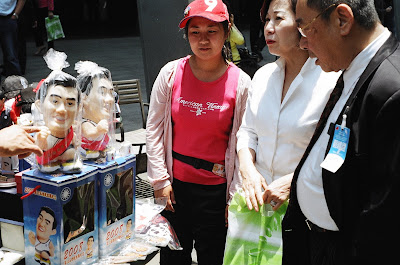
Vendor hawks Ma figurines and hats as customers look on

Inauguration excitement was palpable in Taipei Tuesday. Vendors hawked Ma figurines, baseball hats, and commemorative stamps outside the arena where a concert and his address took place.

As he watched a performance by rocker Wu Bai – Taiwan's answer to Bruce Springsteen – on a giant screen outside the arena, Cheng Yi-yin explained why he skipped work to join the celebration.

"I love Ma Ying-jeou," said Mr. Cheng, holding Taiwan's national flag. "He'll help Taiwan. The KMT wants the status quo – no independence and no unification. I think that's better for the Taiwanese people, because nobody likes war."

Ma supporter Cheng Yi-yin, outside Taipei Arena

Most analysts agree that Ma should be able to expand cross-strait economic links. But some say he may have raised expectations on political progress too high.

The economic agenda includes expanding direct flights and shipping links, allowing more Chinese tourists into Taiwan, and relaxing limits on investment.

Ma also wants to end the diplomatic battle for allies, discuss expanding Taiwan's participation in international groups like the World Health Organization, and formally end decades of hostilities.

On such issues, the extent of China's goodwill remains unclear. "The ball is in Beijing's court," says Lo Chih-cheng, a political scientist at Soochow University in Taipei. "Economic links can be resolved on the basis of the '92 consensus, but when it comes to issues of international space and a peace accord, I'm not sure if that will be good enough for Beijing."
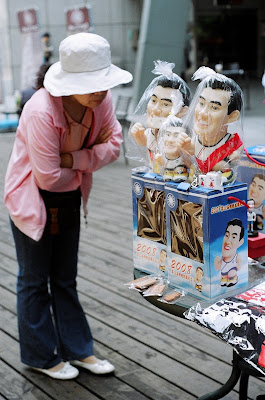
Customer inspects Ma figurines outside Taipei Arena

Ma also risks a backlash at home if he's seen as too cozy with China. The pro-independence party rejects the 1992 consensus as a dangerous downgrade of sovereignty. And many party members fear that economic integration could give Beijing too much leverage over the island.

Ma has ruled out unification in his term. In his address, he emphasized Taiwan's democratic achievements and held up the island as a political model for China.

Since a landmark visit by a top KMT official to China in 2005, Ma's party has forged a detailed consensus with Beijing on economic and cultural exchanges. Ma's challenge now is to expand that consensus to his political opponents in Taiwan.

That process could slow economic integration and nix riskier political overtures by Ma. "In two or three years, many people in Taiwan may say, 'Maybe we've gone too far, too fast,' " says Joseph Cheng, a political analyst at City University of Hong Kong. "So he'll have to move carefully."

Ma supporter Rocky Chou waves Ma flag outside Taipei Arena

For now, many Taiwanese are focused on economic issues. "We're an independent country now," said Cheng Yi-yin. "With Ma, cross-strait economics should improve fast. But for politics, it may take 100 or 200 years to resolve this problem."

He pointed skyward and smiled. "I think the stock market will go up, too."

Original site

A flawed patriot

Chen Shui-bian leaves office a deeply unpopular man. But even his critics credit him for greatly strengthening Taiwan identity

by Jonathan Adams
Newsweek Japan, May 19 issue

In the center of Taipei, at a popular tourist site, is one of the most visible -- and controversial – signs of Chen Shui-bian's legacy. Last December, Chen's government pried from the arch above the plaza four characters, 大中至正, a reference to the late dictator Chiang Kai-shek.

In its place, they attached four new ones: 自由廣場 -- Liberty Plaza.

That small change was symbolic of Chen's main achievement: throwing out many of the remaining signs of the Kuomintang's authoritarian regime, and consolidating Taiwan's democracy and national identity.

The former Chiang Kai-shek Memorial Hall, before the name change

To be sure, by the end of his eight-year term – Chen steps down Tuesday -- a cynical public had little patience for such symbolic changes. They saw Chen and his Democratic Progressive Party (DPP) stirring up needless culture wars and controversy while neglecting the economy. And even his own past supporters became disillusioned by his government's bungling, corrupt rule.

"Many people are heartbroken because of Ah-bian [Chen's nickname]", said Antonio Chiang, a former pro-democracy journalist in the martial law era, and member of Chen's National Security Council. "We worked so hard, and sacrificed so much, and then he threw it all in the river."

History will likely be more kind to Chen. Though deeply flawed, he presided over a critical period of maturation for Taiwan's young democracy. This was the fruit of a long process begun by the DPP and other activists more than twenty years ago.

Under his watch, Taiwan scrapped the National Assembly -- one of the last major institutions of the authoritarian past. Taiwanese people gained the right of referendum in 2003, and the right to approve constitutional revisions in 2005.

Chen's contribution to democracy included strong support for freedom of expression and an independent judiciary. His government accepted the scrutiny of the press and courts to an unprecedented degree in Taiwan's history.

The island's media -- recently ranked Asia's freest by the US non-governmental organization Freedom House –- broadcast relentless criticisms of Chen, much of it deserved. For example, some TV stations ran 'round-the-clock, clearly partisan coverage of anti-Chen protests in the fall of 2006, without interference from Chen's government.


Anti-Chen protesters throng downtown Taipei in the fall of 2006

Taiwan's judiciary remains a work in progress, but Chen's government by and large submitted itself to the rule of law. Ironically, this was part of his downfall: independent prosecutors traced corruption back to his own top aides and relatives; Chen himself may be charged after leaving office.

"All the talk about the DPP being the most corrupt government in Taiwan's history, I don't think that's true," said Bruce Jacobs, head of the Taiwan Research Unit at Australia's Monash University. "What was true is that people who were corrupt got pulled in and convicted." Dirty practices that were routine under the Kuomintang government were exposed and punished under Chen.

Consolidating Taiwan identity – a process begun by his predecessor Lee Teng-hui – may be Chen's most significant legacy. More people now identify as "Taiwanese only," (44%, up from 37% when Chen took office) and fewer as "Chinese only" (5% now, down from13% when he took office).

Even his harshest critics give Chen credit for challenging Taiwanese to reflect on their heritage and identity.


"He used a very unconventional way to provoke people to think about Taiwan's status," said Liao Da-chi, a political analyst at National Sun Yat-sen University in Kaohsiung. "He made us think about ourselves and our position in the world."

His conservative successor, Ma Ying-jeou, represents a sharp contrast to Chen. But the "status quo" Ma will conserve is one now firmly rooted in a sense of Taiwan-first pride. Indeed, Ma got elected by copying the DPP and embracing the patriotism Chen fostered. He took pains to learn phrases in Taiwanese, Hakka and Aboriginal tongues, and spent months of his campaign in the south, soaking up rural culture.

Will Taiwan's democracy and identity be rolled back under the new administration? One test will be whether Ma removes the sign 自由廣場, as some KMT supporters would like. The inscription may seem like a small matter.

But as a symbol of Taiwan's hard-won democratic gains, Ma will likely think twice before changing it.

Anti-Chen protester, fall 2006

Thursday, May 8, 2008

Devious diplomacy

In battle with China for allies, Taiwan resorts to riskier tactics

By Jonathan Adams
International Herald Tribune, May 8, 2008

TAIPEI: A scandal here over a bungled Taiwan attempt to forge official ties with Papua New Guinea has thrown a spotlight on the long-running, shadowy war between China and Taiwan for allies.

Each refuses to establish official ties with countries that maintain ties with the other. All the major powers recognize Beijing, but the two sides have long competed for the allegiances of smaller countries, using promises of aid.

China has gained a distinct edge in that global contest as its booming economy has swelled state coffers and its diplomacy has grown more sophisticated, experts say.

Proof of that is in the dwindling list of allies of Taiwan. In 2000, 30 countries recognized Taiwan; now it counts only 23 small, marginal nations.

Faced with that trend, an increasingly desperate Taiwan is being forced to adopt more devious tactics, analysts say. The latest flap provides just one example.

"It used to be Taiwan was seen as a more prosperous donor and better ally, while the P.R.C. didn't have very many resources," Anthony Van Fossen, an expert on the political economy of the South Pacific at Griffith University in Australia, said by telephone, using the abbreviation of the mainland government's formal name, the People's Republic of China.

"That's all changed," he added. "Now, Pacific nations are quite rightly seeing the P.R.C. as a rising power with huge reserves, and see huge economic benefit in aligning themselves with the P.R.C."


The pro-independence government of Taiwan has been embarrassed by disclosures that it enlisted two middlemen in 2006 in a secret attempt to lure Papua New Guinea to its side with cash. To that end, the Taiwan Foreign Ministry wired about $30 million to an account in Singapore controlled by the intermediaries.

After talks with Papua New Guinea broke down, Taipei demanded the money back from the middlemen, but to no avail. Now, the authorities are trying to determine what happened to one of the men and the cash.

Three top officials, including the foreign minister, resigned Tuesday over the case. Prosecutors raided their homes on suspicion that some of the money may have been earmarked as kickbacks for Taiwan officials. The Taiwan Foreign Ministry denied that any of its officials had received kickbacks, as did former Vice Prime Minister Chiou I-jen, a central figure in the affair.

Analysts point to a similar effort by Taiwan to lure Papua New Guinea to its side in 1999. Media reports at that time said a $2.35 billion aid package had been assembled for the country if it switched its diplomatic ties from Beijing to Taiwan. That effort failed, in part because of Australian pressure on the Papua New Guinea government, said Van Fossen and Susan Windybank, of The Center for Independent Studies in St. Leonards, Australia.

Van Fossen said the most recent attempt to lure Papua New Guinea shows a change in tactics. The much smaller amount this time around suggests the money was probably targeted at influential individuals, he said, using Singapore to make low-tax, low-profile transfers. The Taiwan Foreign Ministry says the money was intended for aid projects.

"Taiwan has to resort to increasingly covert methods to bribe politicians, because they don't have the lure they had in the past of being more prosperous than China," Van Fossen said.


In Taiwan, the diplomatic blunder has renewed calls for a reconsideration of the island's diplomatic strategy, as the public increasingly questions the utility of spending hundreds of millions on obscure countries of dubious reliability.

Ma Ying-jeou, who leads the Kuomintang government that takes power May 20, has said he wants to call a "truce" in the dollar-diplomacy warfare. In an interview in February, his aide Su Chi - now slated to become the head of the National Security Council in the new government - said Ma would push for talks with Beijing over the issue.

"It's in the P.R.C.'s interest to reach a compromise on international space," Su said. "These issues have been alienating Taiwanese for a long time."

Some analysts are optimistic that a compromise could be found, saying that Beijing wants to engage Ma on a range of economic and political issues. Huang Kwei-bo, a professor of diplomacy at National Chengchi University in Taipei, says that an unofficial truce may already be at hand.

"China has gained more leverage against Taiwan in diplomatic struggles," Huang said. "But Beijing will restrain itself from wooing more countries away from Taiwan, because they want more stable cross-strait relations when Ma Ying-jeou goes into office."

Dialogue has been frozen since 1999, in part because of Beijing's distaste for the pro-independence party, which took office in 2000.

But analysts who lean toward independence say the Kuomintang is too optimistic. Lai I-chung, an executive board member of the Taiwan Thinktank, which has close ties with the pro-independence government, said dollar diplomacy would end only if Taiwan gave up its legal claim to statehood, or if Beijing took away all the island's allies.

"Su Chi is too naïve," Lai said. "He's begging for Beijing's mercy, asking them not to isolate Taiwan."


The South Pacific has long been a key battleground; six of Taiwan's allies are there now. Critics say the battle has worsened political instability in many fragile nations and complicated Australian-led efforts to improve governance in the region.

A former Australian foreign minister, Alexander Downer, recently criticized Taiwan's interference in the Solomon Islands. "There are clearly bribes that are being paid to members of Parliament" by Taiwan, Downer said in an interview with Radio Australia. "That has been undermining the work that we have been doing."

The Pacific nations themselves have grown adept at playing China against Taiwan, selling their allegiances to the highest bidder. By design or not, many funds from Taiwan and China end up going to specific politicians, rather than aid projects that benefit the country's people.

In many South Pacific nations, political candidates look to Taiwan or China to help build huge campaign war chests, Van Fossen and Windybank said.

"There's often a sense that Pacific nations are helpless victims in this global struggle, but they're not," Windybank added. "They've become very adept at fleecing both China and Taiwan to suit their interests."

China's foreign financing is opaque, and experts say it is hard even to estimate how much Chinese cash is going to the region. Like the Taipei government, Beijing officially insists it does not "buy" allies.

Since 2000, Taiwan's foreign aid has become somewhat more transparent, with more aid distributed through the International Cooperation and Development Fund and third parties. The Taiwan Foreign Ministry says the island's total annual aid budget for its 23 allies is about $500 million.

But the recent, failed gambit over Papua New Guinea shows that much financing remains secret - budgeted, managed and brokered by only a few high-ranking, in-the-know Taiwanese officials and their representatives.

Barring a breakthrough by Ma's government in talks with Beijing, many observers expect the diplomatic battle to rage on, as China and Taiwan spend millions to secure the allegiances of obscure states like Kiribati. In the high-stakes political races in many South Pacific countries, Chinese and Taiwanese money is too tempting to resist.

"Either Pacific states have to lift their game and decide some things aren't for sale - which is very unlikely," Windybank said, "or there has to be a happy ending between China and Taiwan."


Original site

Much ado about Ms. Lai

Ma's pick for the Mainland Affairs Council may be trouble -- but not because of her supposed independence bent

by Jonathan Adams
Posted May 8, 2007

Taipei—Last week saw an uproar here over incoming President Ma Ying-jeou’s pick of a “pro-independence” figure to head Taiwan’s Mainland Affairs Council.

One Kuomintang legislator likened Mr. Ma’s pick to offering “pork to Muslims,” saying China would be outraged. The stock market tumbled. And the airwaves and headlines screamed that Mr. Ma, who will take office on May 20, may have written a “bad check”—in other words, that he’d made promises on cross-Strait improvements that he now can’t deliver on.

All this was an over-reaction, to say the least.

Certainly, Mr. Ma’s pick—Ms. Lai Shin-yuan, a former legislator from what used to be a hard-line pro-independence party—was surprising. He could have chosen a more China-friendly figure to head Mainland Affairs.

But one person alone can’t derail Mr. Ma’s plans for cross-Strait progress. If Ms. Lai tries to, she’ll quickly be shown the door. Cross-Strait policy will be formulated by Mr. Ma and his National Security Council (led by Su Chi); Ms. Lai’s job will be to implement it.

As for China, its interest in stabilizing the cross-Strait situation should outweigh small “speed bumps” like this one. With its opaque decision-making process, observers are constantly ascribing prickly emotions to the leadership in Beijing, as if it were a hypersensitive teenager.

In fact, by all indications, Beijing is now taking a far more rational, cool-headed approach to Taiwan than ever before. More evidence of that came with the extremely low-key response to Ms. Lai’s appointment from China’s Taiwan Affairs Office.

Mr. Ma’s pick is also a good sign for those worried he’ll move too close to China. It shows he’s willing to defy and take flak from the hardliners in his own party, in order to seek domestic consensus on his cross-Strait policies. That’s a demonstration of his commitment to Taiwan’s democracy.

Meanwhile, Ms. Lai’s presumed fire-breathing, pro-independence ideology is exaggerated. She has now said repeatedly she fully agrees with Mr. Ma’s cross-Strait stance. That policy, in essence, is to shelve the independence-unification debate and make progress with China on practical economic issues.

Here’s what she wrote in a February 2007 Taipei Times editorial: “The blue-green struggle over the moot point of ‘unification versus independence’ obscures the real problems concerning people’s daily lives. Taiwan is a sovereign and independent nation. There is nothing to argue about. It’s time to move on and leave this false debate behind.”

There are some legitimate reasons for concern about the pick, but not the ones that have gotten the most airtime. It’s another line from Ms. Lai’s editorial that suggests an incompatibility with Mr. Ma’s agenda: “Our historic mission at present should be to speak up for all the working people who have been oppressed . . . and fight for their interests.”

Ms. Lai’s social justice and protectionist bent is abundantly evident in her legislative track record. By contrast, many of Mr. Ma’s cross-Strait policies are decidedly pro-business and pro-investor. This may be the real, irreconcilable difference between her and Mr. Ma—not the exaggerated independence issue.

One key test: Will Ms. Lai go along with Mr. Ma’s proposal to lift caps on China-bound investment when her party has adamantly opposed doing so in the past?

Last week’s furor also raises troubling questions about how Mr. Ma will govern. He reportedly consulted only a few people before making the decision to appoint Ms. Lai, so that some top KMT officials first heard the news through media reports. If that’s true, it’s a worrisome replay of President Chen Shui-bian’s brand of top-down, unpredictable decision-making.

Lastly, the media firestorm illustrates a key challenge. Everything President Ma does will be scrutinized under the harsh glare of Asia’s freest media (according to the latest Freedom House poll). He’ll need a smart media strategy to keep everyone in his government on the same page—and not talking to each other via the sensationalist media.

That, again, would repeat the same mistakes made by Mr. Chen’s outgoing government.

Mr. Adams is a freelance journalist in Taiwan.

Original site

Wednesday, May 7, 2008

Dude, where's my $30 million?

Taiwan foreign minister resigns over diplomatic blunder

By Jonathan Adams
International Herald Tribune and New York Times, May 7, 2008

TAIPEI: The foreign minister of Taiwan and two other top officials resigned Tuesday over a botched attempt to win diplomatic recognition from Papua New Guinea, a scandal that has stirred public outrage against the outgoing government just two weeks before it is to step down.

Taipei was embarrassed by the public disclosure that about $30 million, which had been intended for Papua New Guinea in exchange for its switching diplomatic allegiance from Beijing, had disappeared.

Foreign Minister James Huang tendered his resignation over the case Tuesday. Vice Premier Chiou I-jen also resigned from the cabinet, a day after he left the Democratic Progressive Party and said that he would retire from politics. Vice Defense Minister Ko Cheng-heng resigned later Tuesday, The Associated Press reported.

In 2006, the government wired the $30 million to an account in Singapore that was controlled by two middlemen who had been enlisted by Taipei for the secret diplomatic gambit. After negotiations with Papua New Guinea foundered, Taiwan requested the money back, but to no avail.

Now, one of the middlemen - Ching Chi-ju - is on the run. The government says it does not know what became of Ching or the money.

The diplomatic scandal is the latest in a series of blows to the government of President Chen Shui-bian, which has been deeply unpopular for its perceived mismanagement of the economy and a string of corruption cases. Chen's Democratic Progressive Party was badly beaten in elections in January and March.

"People feel humiliated by the government's incompetence," said George Tsai, a political analyst at Chinese Culture University in Taipei. "It's a joke to the outside world - how could the government be cheated like this? It's proof to many that they're a bunch of Boy Scouts and amateurs."

Chiou, the vice premier, had been one of the key players in the overture to Papua New Guinea. He insisted Tuesday that he had not pocketed any money in the affair, amid reports in The United Evening News and other news media outlets that some of the $30 million may have been earmarked as kickbacks for Taiwan officials.

Chiou is widely viewed as one of the key architects of the rise to power in 2000 of the pro-independence Democratic Progressive Party. His fall from grace is therefore a sharp blow for a party whose morale had already been low.

Taiwan and China have long engaged in so-called checkbook diplomacy to lure diplomatic allies to their sides. Taiwan and China both refuse to establish official ties with countries that maintain ties with the other. All the major powers recognize Beijing, but the two sides have long competed for the allegiances of smaller countries, using promises of aid.

In recent years, the growing clout of China has given it an edge in this contest. Now, only 23 countries - mostly small, marginal ones - recognize Taiwan, compared with 30 when the pro-independence party took power in 2000.

Original site, IHT
Original site, NYT